01 — Blind Spot Elimination
Warehouse Blind Spot Safety Solutions
Sensors, gates, visual alerts, and speed management — layered to eliminate danger at every blind corner.
01 — Blind Spot Elimination
Why Are Blind Spots the Primary Forklift Incident Location?
The majority of serious forklift-pedestrian incidents occur at blind corners, racking intersections, and dock door approaches — locations where sight lines are obstructed and neither the operator nor the pedestrian can see each other until they are within feet of contact. Standard countermeasures like mirrors and convex reflectors help with awareness but require both parties to be looking at exactly the right moment.
Engineering controls address this structural limitation: sensors detect regardless of where operators and pedestrians are looking, automated speed reduction responds regardless of driver attention, and visual alerts activate before the forklift arrives at the danger point. OSHA 1910.
178 specifically requires employers to address these conditions through engineering controls where mirrors and sight-line management alone are insufficient.
02 — Deep Dive
How Does IES Use a Multi-Layered Approach to Blind Spot Safety?
No single technology eliminates all blind spot risk. IES designs layered controls where multiple systems work simultaneously and independently, so no single point of failure exposes the facility to uncontrolled risk.
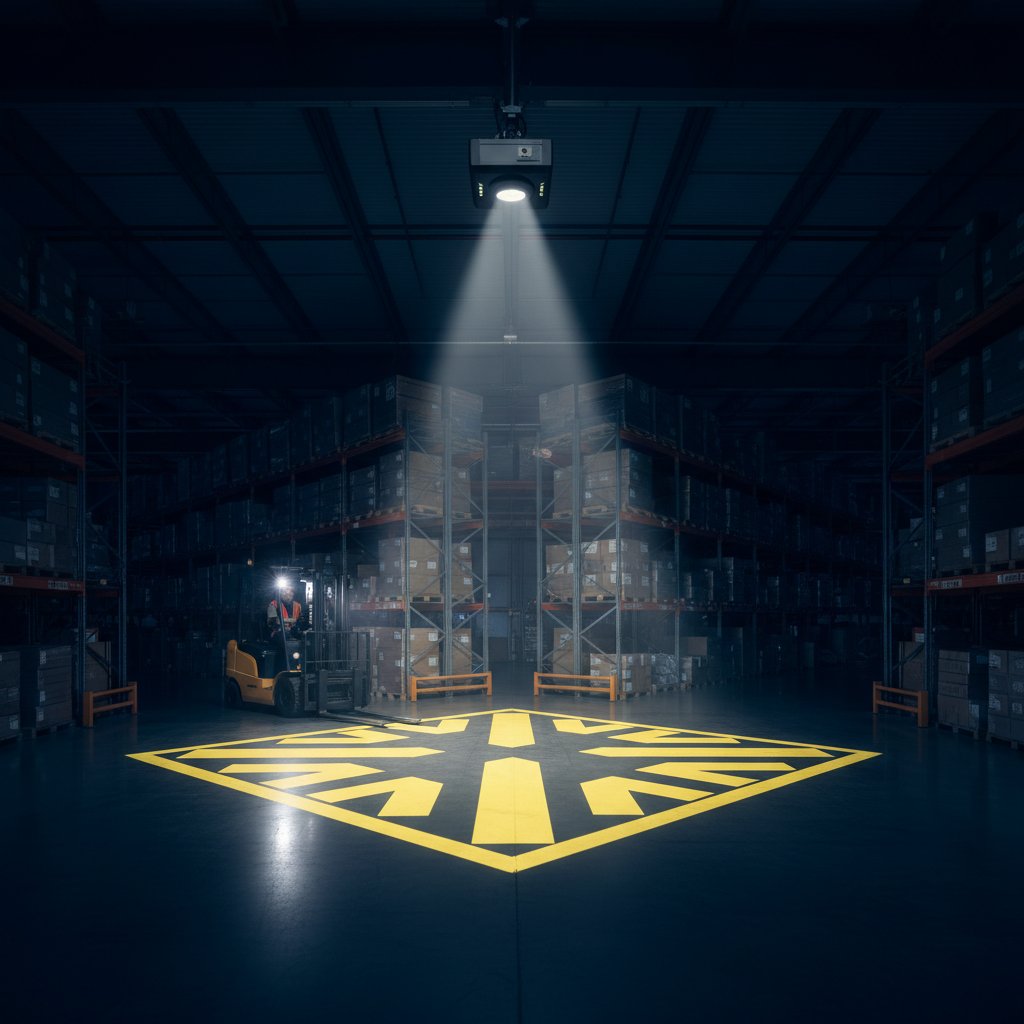
At a typical blind corner, Guardian applies zone-based speed reduction as the forklift approaches; RFID pedestrian detection triggers additional slowdown and alerts if a fob-carrying person is in the area; overhead projectors mounted at the corner cast warning light on both sides of the intersection; and a forklift-mounted blue spot light warns pedestrians of approach before the forklift is visible. Gate arms can be added at the highest-risk intersections to physically control pedestrian access.
Every detection event at each blind spot is logged for compliance and pattern analysis.
03 — Implementation
How Does IES Map and Address Every Blind Spot in Your Facility?
Effective blind spot engineering starts with a complete facility traffic assessment — a systematic walk of every aisle, intersection, racking end, dock door, and office entry point where forklifts and people share space. IES documents each location with traffic volumes, sight line distances, current controls, and incident or near-miss history.
Each blind spot receives an individual engineering solution based on its specific characteristics: traffic volume, pedestrian density, forklift speed in the area, and structural constraints. A high-volume dock crossing needs different treatment than a low-frequency racking end corner.
Post-installation, Guardian's event logging shows which blind spots generate the highest activity, enabling continuous refinement of the control configuration.
Frequently Asked Questions
Get Started
Ready to eliminate your blind spots?
How it works
Answer 7 quick questions about your facility and get an instant risk score with tailored recommendations.
- Evaluate your facility type, fleet size, and traffic patterns
- Instant risk score from 1–10
- Tailored engineering control recommendations
Takes about 2 minutes · No obligation