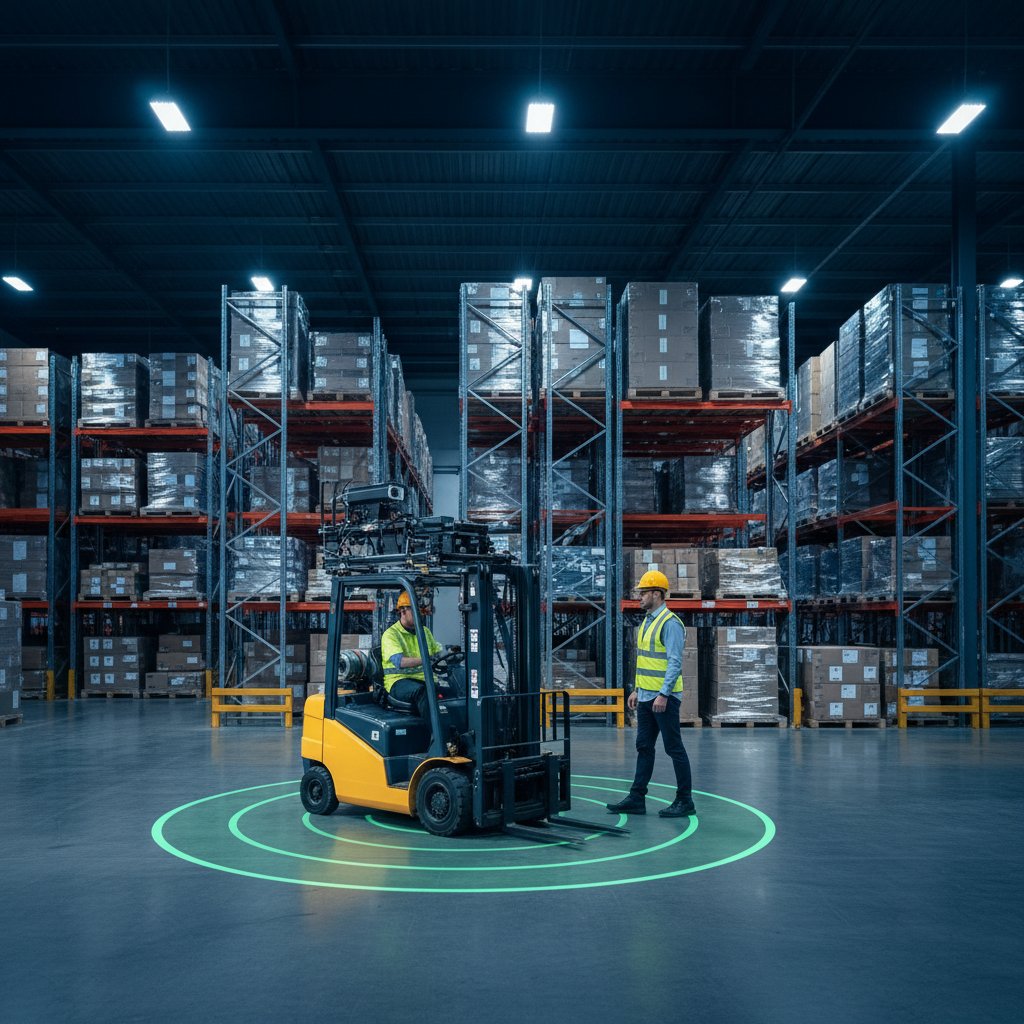
01 — Pedestrian Protection
Forklift Pedestrian Alert System | Proximity Detection
Wearable fob detection, visual alerts, and automated forklift response that protect pedestrians in mixed-traffic environments — no driver action required.
01 — Pedestrian Protection
How Do Forklift Pedestrian Alert Systems Work?
When a fob-carrying pedestrian enters a forklift's configurable detection zone — typically 10–30 feet depending on the area — Guardian triggers a coordinated response: audible and visual alerts activate on the forklift and for the pedestrian, and the forklift automatically slows to a pre-configured safe speed. The pedestrian fob is a small wearable device, typically worn on a vest or lanyard, that communicates with forklift-mounted RFID receivers.
Detection is bidirectional — both the operator and pedestrian receive alerts simultaneously. The system handles multi-forklift environments where both vehicles receive alerts when converging.
Every detection event is logged with forklift ID, zone, time, and pedestrian fob ID.
02 — Deep Dive
What Does a Forklift Pedestrian Alert System Do Beyond Basic Alerts?
IES pedestrian alert systems coordinate a multi-layer response. When a fob is detected, the forklift speed drops automatically to a configurable limit for that zone.
Forklift-mounted projectors flash warning patterns visible to approaching pedestrians. Bay indicators or overhead projectors in the zone activate.
The system logs the event with full data: forklift ID, fob ID, zone, time, and response triggered. This logged data becomes an audit trail for OSHA compliance and provides pattern analysis to identify which zones generate the most proximity events — informing future engineering decisions.
Supervisors can access event reports without interrupting operations.
03 — Implementation
How Is the System Configured for Complex Facility Environments?
Every facility has unique pedestrian-forklift conflict zones: cross-aisles where forklifts travel at full speed intersecting pedestrian walkways, dock areas where trucks unload while forklifts move product, and areas where temporary workers or contractors may not be familiar with traffic patterns. IES configures detection zones, alert trigger thresholds, and speed response protocols individually for each high-risk area during the initial facility traffic assessment.
Zones can be set to different sensitivity levels — a narrower detection zone in an open aisle, wider zones at blind corners. The system is software-configurable after installation, so zone parameters can be adjusted as your facility layout or operations change.
Frequently Asked Questions
Get Started
Ready to eliminate your blind spots?
How it works
Answer 7 quick questions about your facility and get an instant risk score with tailored recommendations.
- Evaluate your facility type, fleet size, and traffic patterns
- Instant risk score from 1–10
- Tailored engineering control recommendations
Takes about 2 minutes · No obligation