01 — Visual Communication
Visual Alert Systems for Warehouses | LED & Projection
LED indicators, overhead projectors, floor-projected warnings, and beacon systems that provide clear, unmistakable visual communication in noisy warehouse environments — integrated with Guardian detection.
01 — Visual Communication
Why Do Visual Alert Systems Outperform Audible Alarms in Warehouses?
Warehouses are acoustically challenging environments. Forklifts, conveyors, pallet jacks, HVAC systems, and ambient activity create continuous background noise that masks audible alarms — especially at the distances where warning is most valuable.
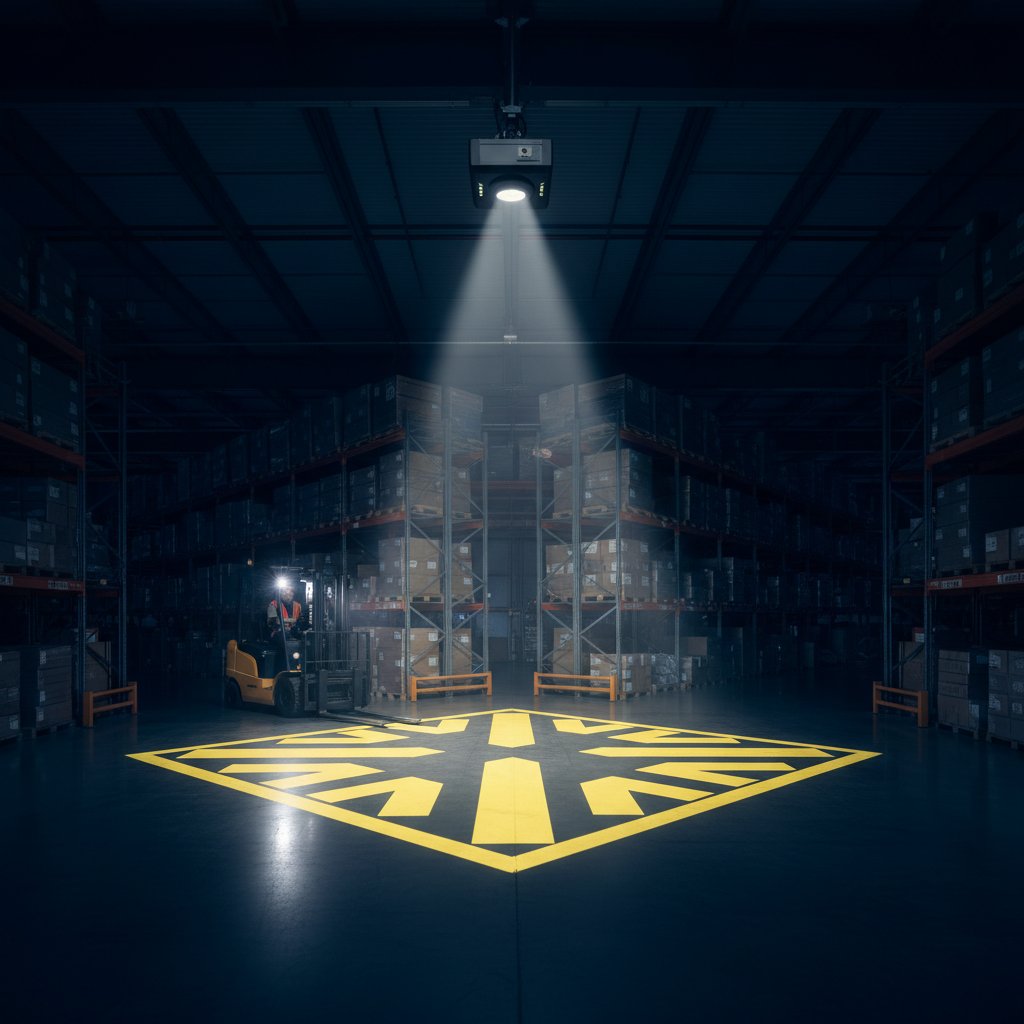
A pedestrian 20 feet from an approaching forklift may not hear a horn or alarm until they are already in the danger zone. Visual warning systems bypass the auditory channel entirely: projected floor markings, overhead warning lights, and LED bay door indicators are visible across distance and in any noise environment.
They also provide directional information — a blue spot on the floor tells a pedestrian not just that a forklift is nearby, but exactly where it is approaching from.
02 — Deep Dive
What Types of Visual Alert Systems Does IES Install?
IES installs the full range of facility and forklift-mounted visual alert equipment. Bay door LED indicators — green, amber, and red — communicate dock status to forklift operators approaching from the aisle, preventing entry during unsafe conditions.
Blue spot lights project a bright floor-level warning 10–20 feet ahead of a forklift at blind corners. Overhead projectors mounted to racking or ceiling structures cast warning zones at fixed high-risk intersections.
Arc warning lights project curved patterns around the forklift perimeter. Floor-projected speed limit indicators display active zone speeds in real time.
Digital display boards provide zone status at high-traffic decision points. Beacon lights on facility structures provide wide-area visual signals during proximity events.
03 — Implementation
How Do Visual Alerts Connect to Guardian's Detection Network?
Visual alerts provide their highest value when they respond to real conditions rather than running continuously. Connected to Guardian's detection network, visual alerts activate based on actual proximity events — a pedestrian entering a detection zone, a forklift approaching an intersection, a dock door changing status.
This event-driven activation eliminates alert fatigue: when lights run only in response to genuine hazard conditions, workers do not habituate to them as background noise. Every activation event is logged with forklift ID, zone, and timestamp for OSHA compliance documentation.
Bay door indicators update automatically when dock activity changes, giving approaching operators accurate real-time dock status without radio coordination.
Frequently Asked Questions
Get Started
Ready to eliminate your blind spots?
How it works
Answer 7 quick questions about your facility and get an instant risk score with tailored recommendations.
- Evaluate your facility type, fleet size, and traffic patterns
- Instant risk score from 1–10
- Tailored engineering control recommendations
Takes about 2 minutes · No obligation