01 — Collision Prevention Engineering
Forklift Collision Avoidance Systems
Forklift collision avoidance systems that detect hazardous proximity, alert operators and pedestrians, and automatically intervene to prevent contact — before an incident occurs.
01 — Collision Prevention Engineering
How Does Forklift Collision Avoidance Work: Detect → Alert → Intervene?
Effective collision avoidance engineering follows a three-stage logic. Detection identifies the hazardous condition: a pedestrian in a forklift's travel path, two forklifts converging at an intersection, or a forklift approaching a blind corner at speed.
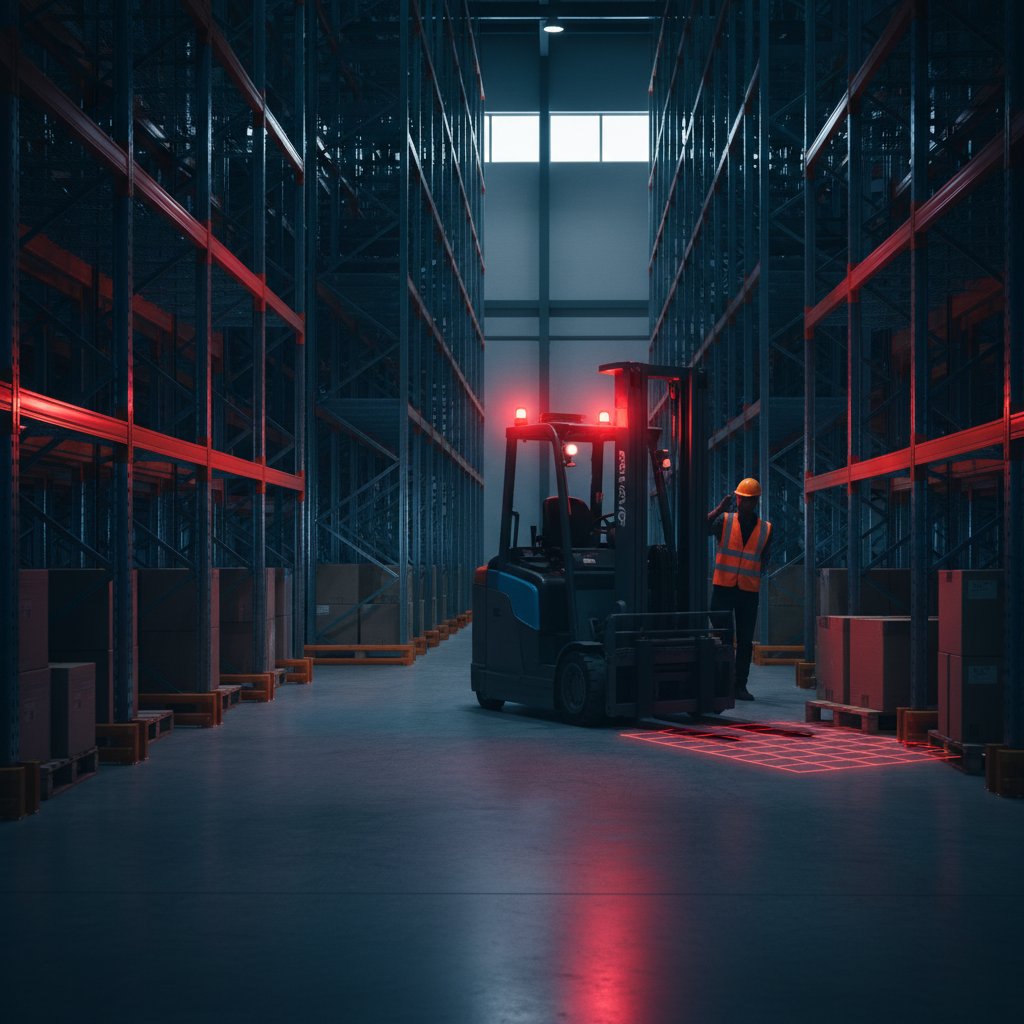
Alert communicates the condition to both parties simultaneously — visual and audible signals for the operator, floor-projected warnings and personal fob vibration for the pedestrian. Intervention changes the outcome: the forklift automatically slows to a safe speed, gate arms lower to prevent pedestrian entry into the conflict zone, and the event is logged with full data.
The intervention layer is what separates collision avoidance systems from simple proximity awareness devices — it acts regardless of human reaction time.
02 — Deep Dive
What Types of Forklift Collision Avoidance Systems Are Available?
Collision avoidance systems vary by detection technology and intervention capability. Basic proximity alert systems detect and warn but do not intervene — useful for low-density environments where awareness alone meaningfully improves safety margins.
Detection-plus-slowdown systems reduce forklift speed automatically when a proximity event is detected, removing the dependence on operator reaction time. Full collision avoidance integrations combine detection, automatic speed reduction, visual and audible alerts for both parties, gate arm control at pedestrian crossings, and comprehensive event logging.
IES recommends the appropriate system tier based on your facility's traffic density, incident history, and the severity of consequences at each conflict zone.
03 — Implementation
What Is the ROI and Incident Reduction Case for Collision Avoidance?
The business case for forklift collision avoidance engineering includes several measurable components. Direct incident costs — medical expenses, workers' compensation claims, property damage, OSHA investigation exposure, and potential litigation — are the most visible.
Operational disruption costs are often underestimated: when a serious incident occurs, facilities typically shut down the affected zone for investigation, lose productivity during the OSHA review period, and face significant management time demands. OSHA 1910.
178 citations follow employers who document hazard awareness without implementing available engineering controls. Many facilities find that preventing a single serious incident covers the full system installation cost.
IES provides ROI analysis during the traffic assessment process.
Frequently Asked Questions
Get Started
Ready to eliminate your blind spots?
How it works
Answer 7 quick questions about your facility and get an instant risk score with tailored recommendations.
- Evaluate your facility type, fleet size, and traffic patterns
- Instant risk score from 1–10
- Tailored engineering control recommendations
Takes about 2 minutes · No obligation