01 — Proximity Detection Technology
Forklift Proximity Sensors & Detection Systems
Forklift proximity sensors and detection systems that identify hazardous proximity events in real time — and connect automatically to speed management and visual alerts.
01 — Proximity Detection Technology
How Do Forklift Proximity Sensors Work?
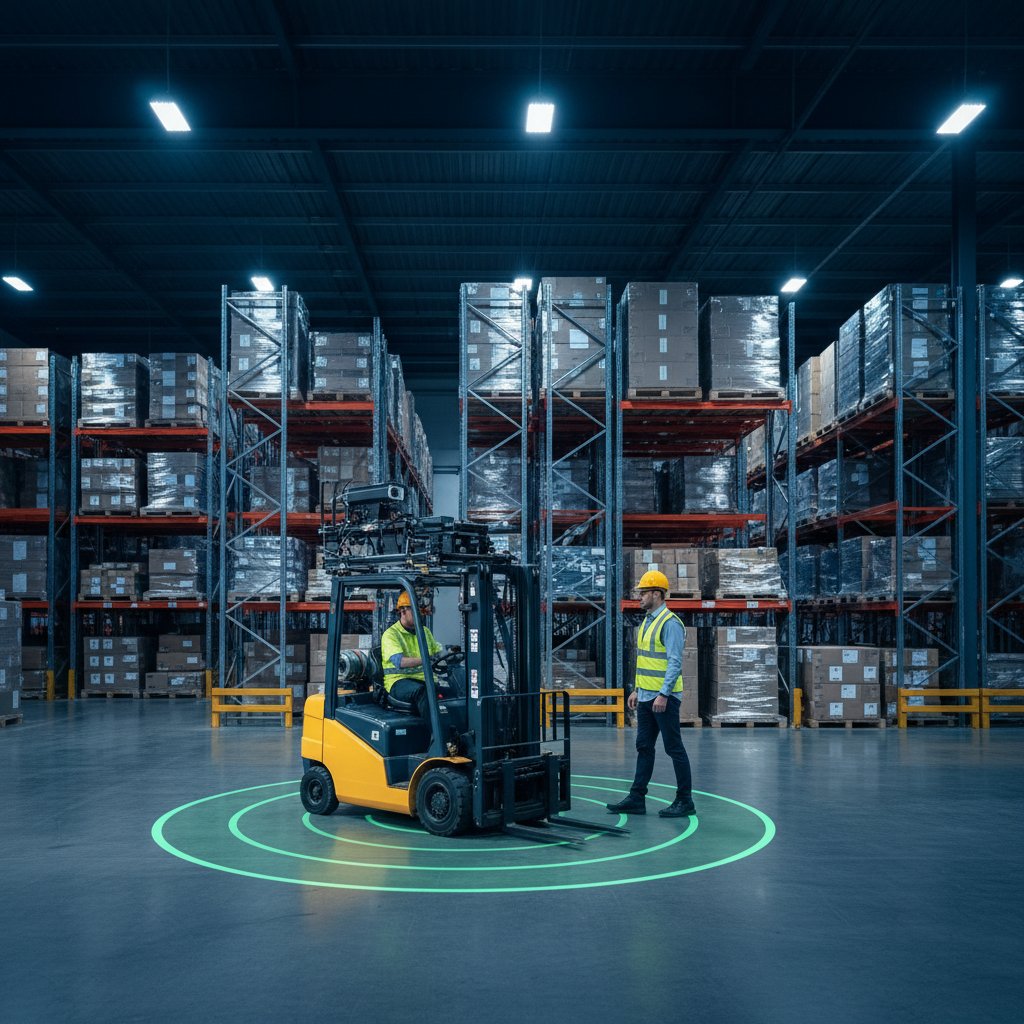
Proximity sensors create a configurable detection field around a forklift — typically 10–30 feet depending on the zone and technology — and trigger a coordinated response when another object enters that field. RFID fob systems detect wearable pedestrian fobs that enter the forklift's reader range; they are reliable, cost-effective, and widely deployed.
UWB (ultra-wideband) sensors provide precise real-time positioning of both forklifts and tagged pedestrians, enabling more granular zone management. LiDAR sensors use laser scanning to detect any object within the detection plane without requiring a wearable tag.
Camera-based systems add visual data, enabling differentiation between pedestrians and pallets. IES selects the appropriate technology for each facility based on traffic density, tag adoption requirements, and integration goals.
02 — Deep Dive
How Does Proximity Detection Connect to Speed Management and Alerts?
Proximity detection alone — a beep when something is close — addresses only the awareness layer of the safety problem. For engineering controls that change operational outcomes, detection must connect directly to intervention.
In Guardian-integrated facilities, a proximity event simultaneously triggers multiple responses: forklift speed reduces to a pre-configured safe limit, visual alerts activate on the forklift and for the pedestrian, overhead projectors flash at the intersection, and the event is logged with forklift ID, fob ID, zone, and timestamp. This coordinated response means neither the operator's reaction time nor the pedestrian's awareness determines whether an incident occurs — the system intervenes automatically regardless of human attention at the critical moment.
03 — Implementation
What Are the Benefits of Fleet-Wide Proximity Sensor Deployment?
Installing proximity sensors on one or two forklifts addresses the risk profile of those specific vehicles. Fleet-wide deployment changes the operational environment of the entire facility.
When every forklift is equipped, pedestrians receive consistent protection regardless of which vehicle is approaching. Supervisors can review event data across the entire fleet to identify which zones, shifts, or operators generate the most proximity events — enabling targeted interventions beyond equipment.
Fleet-wide deployment also enables multi-forklift proximity events: when two Guardian-equipped forklifts converge at an intersection, both receive alerts and both slow down simultaneously. IES designs fleet-wide deployment programs that phase the rollout to minimize operational disruption.
Frequently Asked Questions
Get Started
Ready to eliminate your blind spots?
How it works
Answer 7 quick questions about your facility and get an instant risk score with tailored recommendations.
- Evaluate your facility type, fleet size, and traffic patterns
- Instant risk score from 1–10
- Tailored engineering control recommendations
Takes about 2 minutes · No obligation