01 — Safety System Cost Guide
Forklift Safety System Cost: What Facilities Actually Pay
No vendor publishes this page, so here it is: the real ranges for forklift pedestrian detection and collision avoidance — per truck, per zone, and per facility — and the five things that move a quote.
01 — Safety System Cost Guide
Forklift Safety System Cost Ranges, by Scope
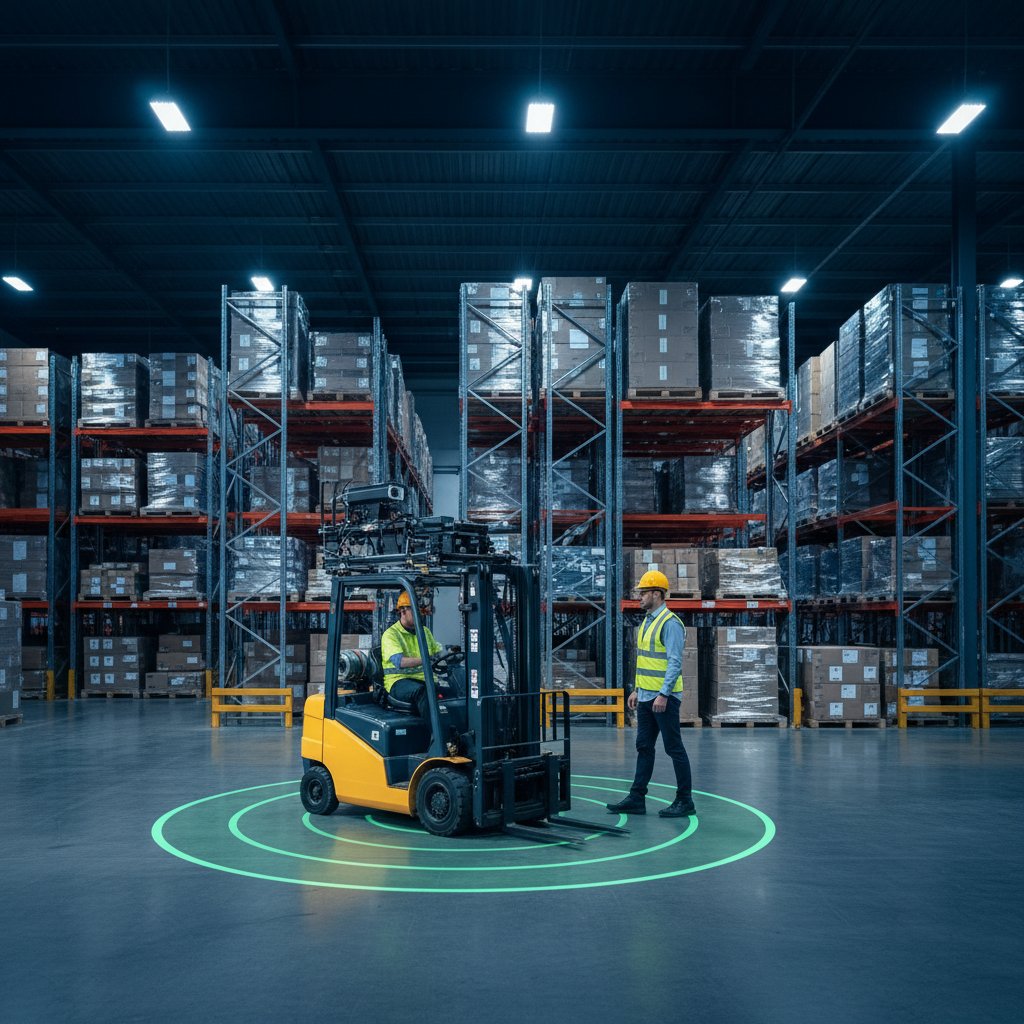
Individual forklift-mounted warning lights start at a few hundred dollars per vehicle — useful as one layer, never as a system. Basic pedestrian detection for 1 forklift and 10 pedestrians starts around $9,500.
Full per-truck integration — detection, speed management, and visual alerts — runs roughly $5,000–$15,000 per forklift depending on sensor technology. A targeted intervention at one high-risk intersection, with detection, speed management, and visual alerts, typically runs $20,000–$50,000.
A full facility deployment covering 10–20 forklifts with Guardian integration, gate arms, and building infrastructure typically ranges from $100,000 to $300,000+. Every one of those ranges is an IES-published figure, consistent across this site — the assessment converts them into a fixed quote for your floor.
02 — Deep Dive
The Five Things That Move a Safety System Quote
Fleet size is the obvious one — per-truck hardware multiplies. Detection technology is the quiet one: fob-based detection is the most cost-effective, UWB adds positional precision, camera and LiDAR systems cost more per truck.
Building infrastructure separates small quotes from large ones — gate arms, traffic lights, and projectors at every crossing cost more than truck-mounted equipment alone, and protect the crossings where incidents actually happen. Zone count matters more than square footage: ten conflict zones in a small facility cost more than three in a large one.
Finally, integration scope: event logging, reporting, and WMS or dock-system connections add engineering time. A quote that does not itemize these five is a quote you cannot compare.
03 — Implementation
The Other Side of the Ledger: What an Incident Costs
OSHA's powered industrial truck standard, 1910. 178, is the fifth most-cited standard in warehousing — and citations are the cheap part of an incident.
A single serious forklift-pedestrian incident carries medical costs, workers' compensation impact, equipment and product damage, the investigation shutdown of the affected zone, management time through the OSHA review, and premium consequences for years. Facilities routinely find that preventing one serious incident covers the full cost of a facility-wide installation — which is why the ROI conversation usually ends quickly once incident history is on the table.
If you are pricing a system because of a near-miss or a citation, you are already holding the business case; the assessment turns it into an engineering plan.
Frequently Asked Questions
Get Started
Ready to eliminate your blind spots?
How it works
Answer 7 quick questions about your facility and get an instant risk score with tailored recommendations.
- Evaluate your facility type, fleet size, and traffic patterns
- Instant risk score from 1–10
- Tailored engineering control recommendations
Takes about 2 minutes · No obligation