01 — Crossing Protection
Warehouse Pedestrian Crossing Safety Solutions
Automated detection, traffic control, and speed management at pedestrian crossing points — protecting workers where forklifts and foot traffic converge.
01 — Crossing Protection
Why Are Painted Lines Insufficient for Pedestrian Crossing Protection?
Floor markings and painted crossing lines establish designated paths but provide no active protection — they communicate expectation without enforcing it. A forklift operator under time pressure, navigating a loaded vehicle at the end of a shift, may enter a crossing without scanning for pedestrians.
A pedestrian focused on a task may step into a crossing without checking for approaching equipment. Engineering controls change the equation: detection systems identify the hazardous condition before it becomes contact, speed management ensures the forklift is traveling at a safe speed as it approaches the crossing, and visual alerts give both parties information before the collision point.
OSHA 1910. 178 requires active engineering controls where training and markings alone are insufficient.
02 — Deep Dive
How Does IES Engineer Automated Pedestrian Crossing Protection?
IES designs pedestrian crossing systems with multiple integrated layers. Infrastructure-mounted proximity sensors detect forklifts approaching the crossing from either direction.
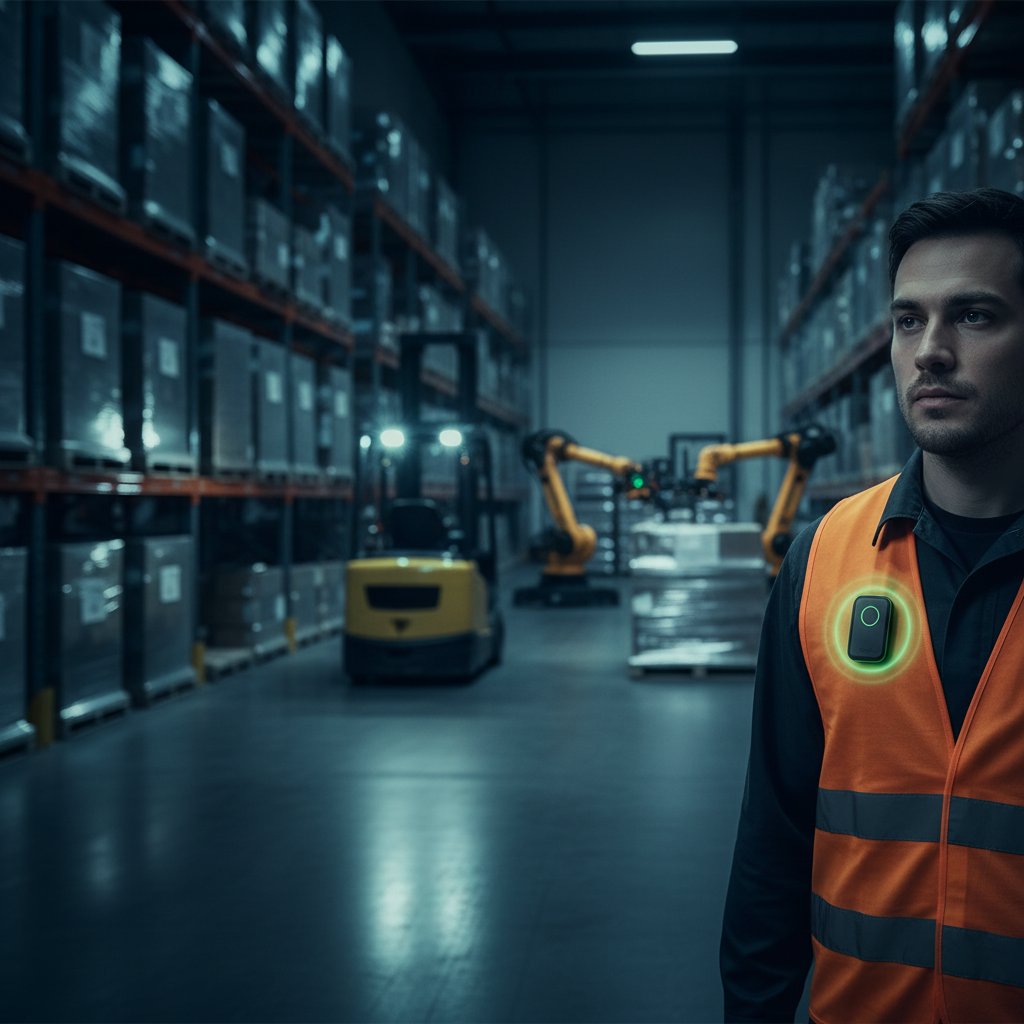
Pedestrian fob detection identifies when a worker is at or near the crossing zone. When both are detected simultaneously, Guardian triggers coordinated alerts: visual warning projections on the floor and walls, audible signals at the crossing, and automatic forklift speed reduction to a safe crossing speed.
Traffic light systems at crossing approaches — green for pedestrians when clear, red when a forklift is approaching — communicate right-of-way clearly. Gate arms at the highest-risk crossings physically prevent pedestrian entry during active forklift movement.
Every interaction is logged for OSHA compliance documentation.
03 — Implementation
How Does IES Design Each Crossing Solution for Different Traffic Volumes?
A main-aisle crossing with 50+ forklift passes per hour needs fundamentally different controls than a secondary crossing with occasional traffic. IES begins with a facility traffic assessment that quantifies crossing volume, forklift speed on approach, pedestrian density, sight line distances, and peak-hour patterns.
From this data, we specify the appropriate control tier for each crossing: a high-volume crossing might receive full gate arm integration with traffic lights and floor projection; a lower-volume crossing might require speed zone management and overhead visual alerts. This risk-stratified approach concentrates investment where the exposure is highest and avoids over-engineering areas where simpler controls are sufficient.
Frequently Asked Questions
Get Started
Ready to eliminate your blind spots?
How it works
Answer 7 quick questions about your facility and get an instant risk score with tailored recommendations.
- Evaluate your facility type, fleet size, and traffic patterns
- Instant risk score from 1–10
- Tailored engineering control recommendations
Takes about 2 minutes · No obligation