01 — Integrated Equipment Solutions
Warehouse Safety Equipment & Engineering Controls
Purpose-built warehouse safety equipment — from proximity sensors and visual warning lights to automated barriers and speed management systems — selected, integrated, and installed by IES.
01 — Integrated Equipment Solutions
Why Does Piecemeal Safety Equipment Leave Dangerous Gaps?
Most facilities acquire warehouse safety equipment incrementally: a few blue spot lights after a near-miss, floor tape after a safety audit, a mirror at the corner that caused an incident. The result is a collection of disconnected devices, each addressing one specific scenario, with no coordination between them.
A blue spot light warns pedestrians but does not slow the forklift. A speed limiter enforces a speed but does not detect pedestrians.
A mirror improves sight lines but requires both parties to be looking at the right moment simultaneously. IES designs integrated equipment systems where each component communicates with the others — detection triggers alerting, alerting coordinates with speed management, and every event is logged for compliance.
02 — Deep Dive
What Types of Warehouse Safety Equipment Does IES Install?
IES installs and integrates the complete range of warehouse engineering control equipment. Proximity sensors and pedestrian detection systems — using RFID fob technology, UWB positioning, or LiDAR — identify when people and equipment share dangerous space in real time.
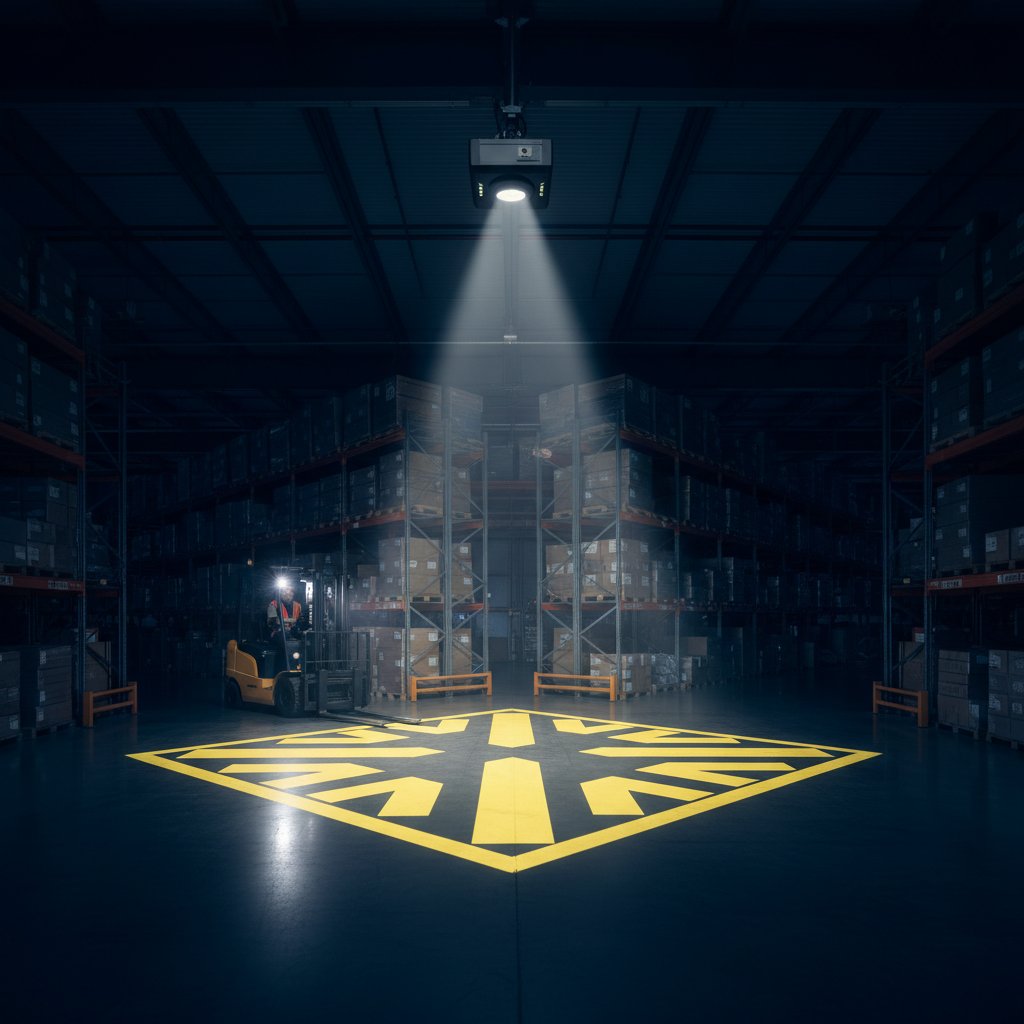
Blue spot lights, red zone projectors, overhead warning projectors, and arc warning lights provide visual communication across the facility. Automated barrier systems and gate arms physically control pedestrian access at high-risk crossing points.
Bay door LED indicators coordinate dock traffic. Zone-based speed management governors enforce location-appropriate speed limits at the forklift throttle level.
Traffic light systems and floor projectors manage intersection right-of-way. All equipment connects through Guardian and logs every safety event for compliance documentation.
03 — Implementation
How Does IES Select and Integrate the Right Safety Equipment for Each Facility?
Equipment selection requires understanding each area's specific risk profile before consulting any product catalog. IES begins with a facility traffic assessment — mapping forklift travel paths, documenting intersection volumes, identifying blind spots, characterizing pedestrian traffic patterns, and reviewing incident and near-miss history.
Each high-risk zone receives an individually specified equipment solution: a high-volume dock crossing needs detection, gate arms, traffic lights, and speed management; a single blind-corner intersection might need an overhead projector and speed zone alone. After installation, Guardian's event logging shows which zones generate the most activity, enabling continuous refinement of equipment configuration as operations evolve.
Frequently Asked Questions
Get Started
Ready to eliminate your blind spots?
How it works
Answer 7 quick questions about your facility and get an instant risk score with tailored recommendations.
- Evaluate your facility type, fleet size, and traffic patterns
- Instant risk score from 1–10
- Tailored engineering control recommendations
Takes about 2 minutes · No obligation