01 — Integrated Safety Engineering
Warehouse Safety Solutions & Engineering Controls
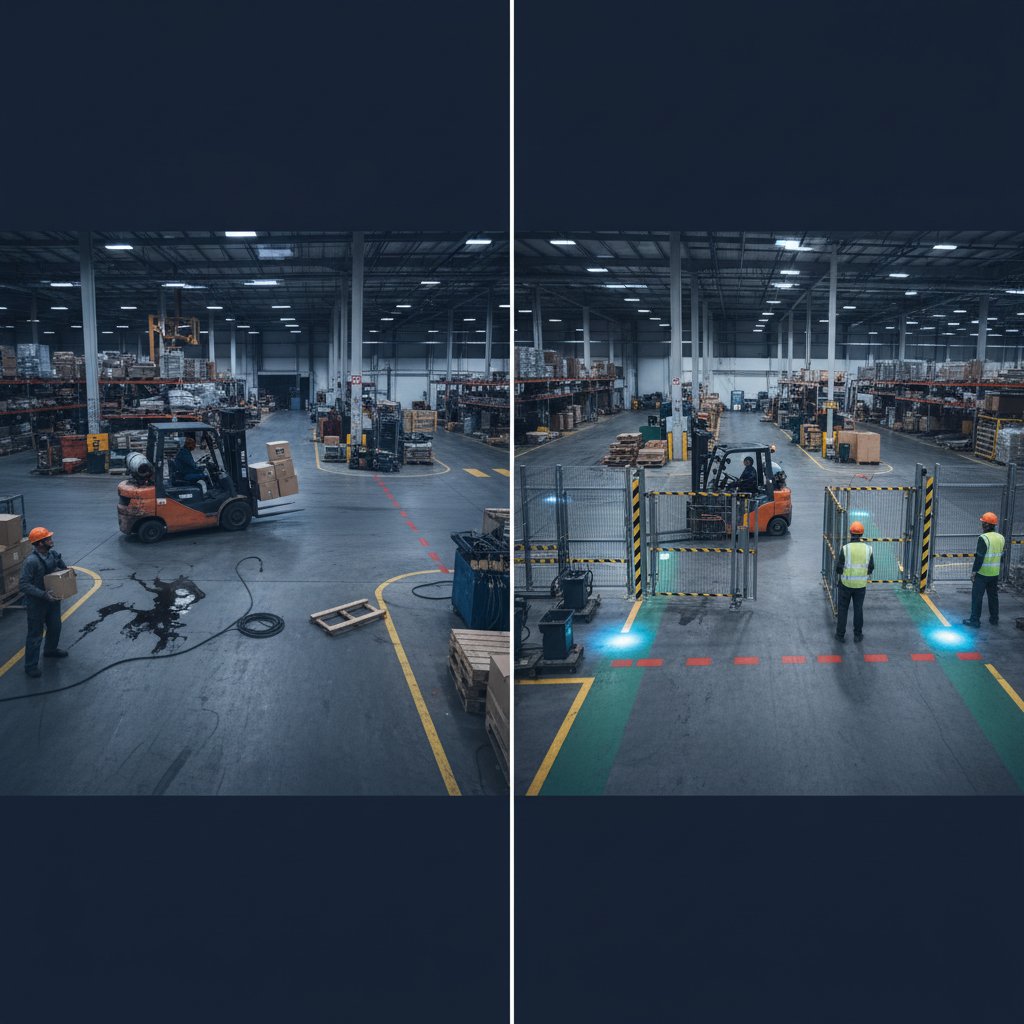
Comprehensive warehouse safety solutions that combine detection, visual alerts, speed management, automated barriers, and building-integrated controls — engineered as one coordinated system.
01 — Integrated Safety Engineering
What Is the Full Spectrum of Warehouse Safety Solution Categories?
Detection and sensing systems identify hazardous conditions before they become incidents: proximity sensors detect when forklifts and pedestrians share dangerous space, vehicle detection monitors dock approaches, and LiDAR scanners identify objects in forklift travel paths. Visual alerting systems communicate hazard status — blue spot lights, overhead projectors, floor-projected warning zones, and bay door LED indicators translate real-time conditions into visible signals.
Speed management systems enforce zone-appropriate forklift speeds automatically without driver input. Barrier and access control systems — gate arms and traffic light systems — physically prevent pedestrians from entering active forklift zones.
OSHA 1910. 178 compliance documentation systems log every detection and intervention event with timestamp, forklift ID, and zone data, creating the audit trail that supports a defensible compliance record.
02 — Deep Dive
How Should You Evaluate Warehouse Safety Solutions for Your Facility?
The starting point for any warehouse safety evaluation is a facility traffic assessment that maps current conditions: traffic patterns, blind spots, intersection volumes, existing controls, and incident and near-miss history. This produces a zone-by-zone risk map showing where engineering controls are absent, inadequate, or disconnected from other systems.
IES conducts this assessment systematically — every aisle, intersection, dock door, and office entry point where forklifts and people share space. Each zone receives an individual specification: what detection technology is appropriate, what alerting systems communicate the hazard, what intervention reduces the exposure, and what logging supports OSHA compliance.
The output is a written engineering specification, not a product catalog — it starts with your facility's conditions rather than a standard product list.
03 — Implementation
Why Does the IES Integrated Approach Outperform Piecemeal Safety Vendors?
The warehouse safety solutions market is fragmented. Most vendors specialize in one product category: one company sells proximity sensors, another sells visual alert lights, a third provides speed management governors.
Each vendor recommends their product regardless of whether it fits your facility's actual risk profile. The result is disconnected systems that do not communicate — a speed limiter that does not know a pedestrian is present, a warning light that runs continuously regardless of conditions, a proximity sensor that alerts but does not slow the forklift.
IES integrates across all product categories as a single-vendor engineering project. One assessment maps all risk zones.
One system connects detection, alerting, intervention, and logging. Every component communicates with every other.
IES designs, installs, and supports the complete system from initial assessment through ongoing support.
Frequently Asked Questions
Get Started
Ready to eliminate your blind spots?
How it works
Answer 7 quick questions about your facility and get an instant risk score with tailored recommendations.
- Evaluate your facility type, fleet size, and traffic patterns
- Instant risk score from 1–10
- Tailored engineering control recommendations
Takes about 2 minutes · No obligation