01 — Traffic Control Infrastructure
Warehouse Traffic Control Systems
Physical traffic control infrastructure for industrial facilities. Gate arms, speed zones, projectors, and detection systems that manage forklift-pedestrian interactions.
01 — Traffic Control Infrastructure
What Is Physical Traffic Control Infrastructure?
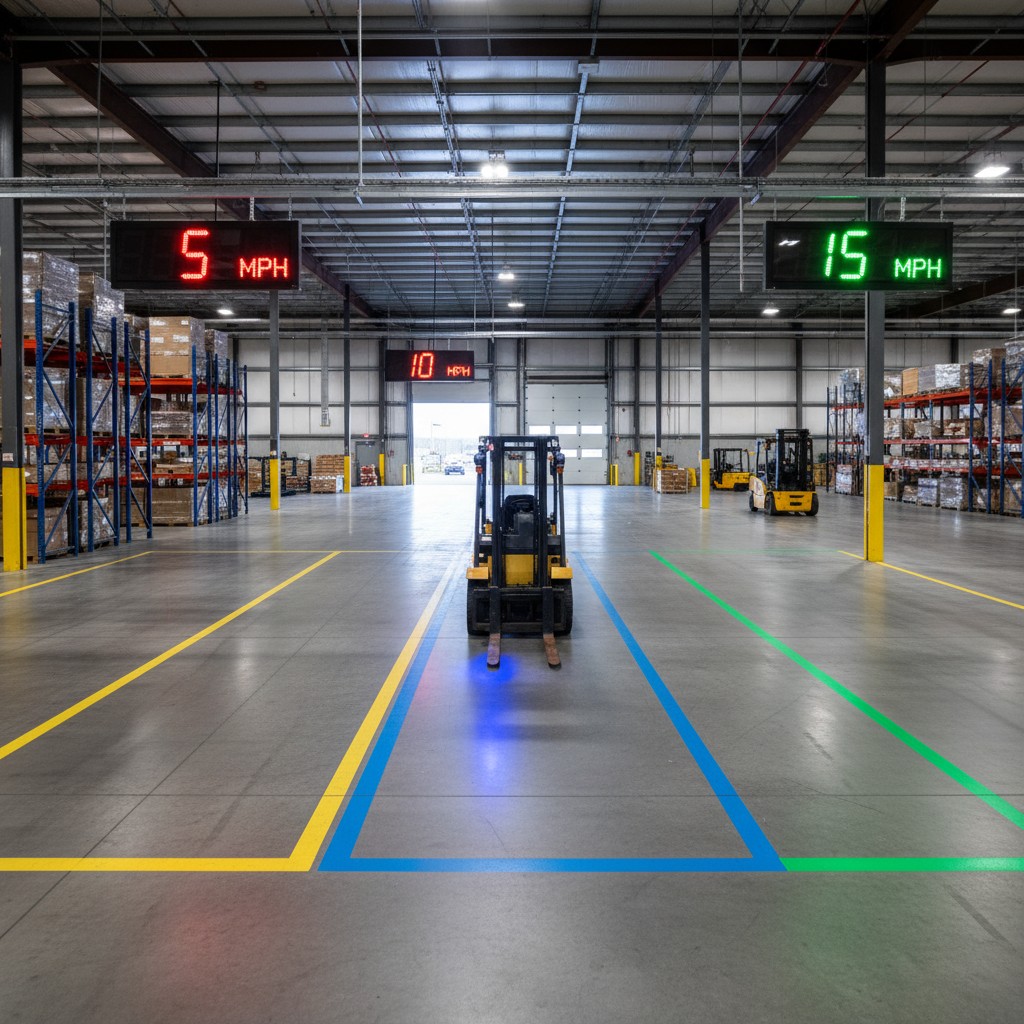
Traffic control in a warehouse is not about signs and floor tape. It is about physical infrastructure that enforces safe traffic patterns regardless of human behavior.
Gate arms stop pedestrian access during forklift movement — not a warning, a physical barrier. Speed zones automatically slow equipment at intersections and blind spots, enforced by the vehicle control system rather than the driver's judgment.
Floor projectors cast real-time hazard zones onto the floor, marking active forklift paths even in noisy environments where audio warnings are missed. Traffic lights coordinate right-of-way at busy crossings.
IES designs and installs all these components as integrated infrastructure — every element communicating with every other so the system responds as a whole, not as a collection of independently installed safety products.
02 — Deep Dive
How Do Gate Arms Control Traffic Flow?
Gate arms are the most direct form of traffic control because they create a physical barrier that cannot be ignored or overlooked. When a forklift is detected approaching a pedestrian crossing, gate arms lower to prevent pedestrians from entering the active traffic path.
The system simultaneously activates overhead warning lights and audible alerts. When the forklift clears the zone, gates raise and pedestrians receive a green signal indicating the crossing is safe.
IES integrates gate arms with detection sensors, traffic lights, and floor projectors so the entire intersection responds as one coordinated system. Gate arm timing, clearance distances, and response sequences are configured based on your specific intersection geometry and traffic volumes.
03 — Implementation
How Do Floor Projectors Improve Warehouse Safety?
Floor projectors cast real-time visual warnings directly onto the warehouse floor, making hazard zones visible at ground level where they are most relevant to pedestrians. Red zones appear when forklifts are approaching an intersection.
Warning symbols mark active travel paths. Speed limit indicators show current zone speeds for operators.
These projections remain visible in high-noise environments where audio warnings are lost, and they work in areas where overhead lighting varies with ambient conditions. IES uses ceiling-mounted projectors for fixed intersection coverage and forklift-mounted projectors for moving hazard zones that follow the vehicle.
Projector placement is determined during facility assessment based on sight lines, traffic volume, and intersection geometry. All projectors integrate with detection sensors and update in real time based on forklift position and speed.
Frequently Asked Questions
Get Started
Ready to eliminate your blind spots?
How it works
Answer 7 quick questions about your facility and get an instant risk score with tailored recommendations.
- Evaluate your facility type, fleet size, and traffic patterns
- Instant risk score from 1–10
- Tailored engineering control recommendations
Takes about 2 minutes · No obligation