01 — Traffic Management Systems
Warehouse Traffic Management Systems
Engineered traffic control for facilities where forklifts and pedestrians share the same space. Detection, speed management, visual alerts, and building-integrated controls.
01 — Traffic Management Systems
Why Does Traffic Management Prevent Incidents?
In facilities where forklifts and pedestrians share aisles, intersections, and dock areas, unmanaged traffic flow is the leading source of serious incidents. OSHA data shows that 80% of forklift incidents involve a pedestrian, and OSHA 1910.
178 ranks as the 8th most-cited workplace violation. The root cause is rarely equipment failure alone — it is the absence of engineered infrastructure to control how traffic flows.
Facilities that rely on floor markings, training, and verbal rules see repeated near-misses because those measures depend on human compliance in every interaction. Engineering controls that manage traffic flow — not just warn about it — physically enforce safe behavior and dramatically reduce this exposure regardless of operator attention or experience.
02 — Deep Dive
How Does IES Manage Facility Traffic?
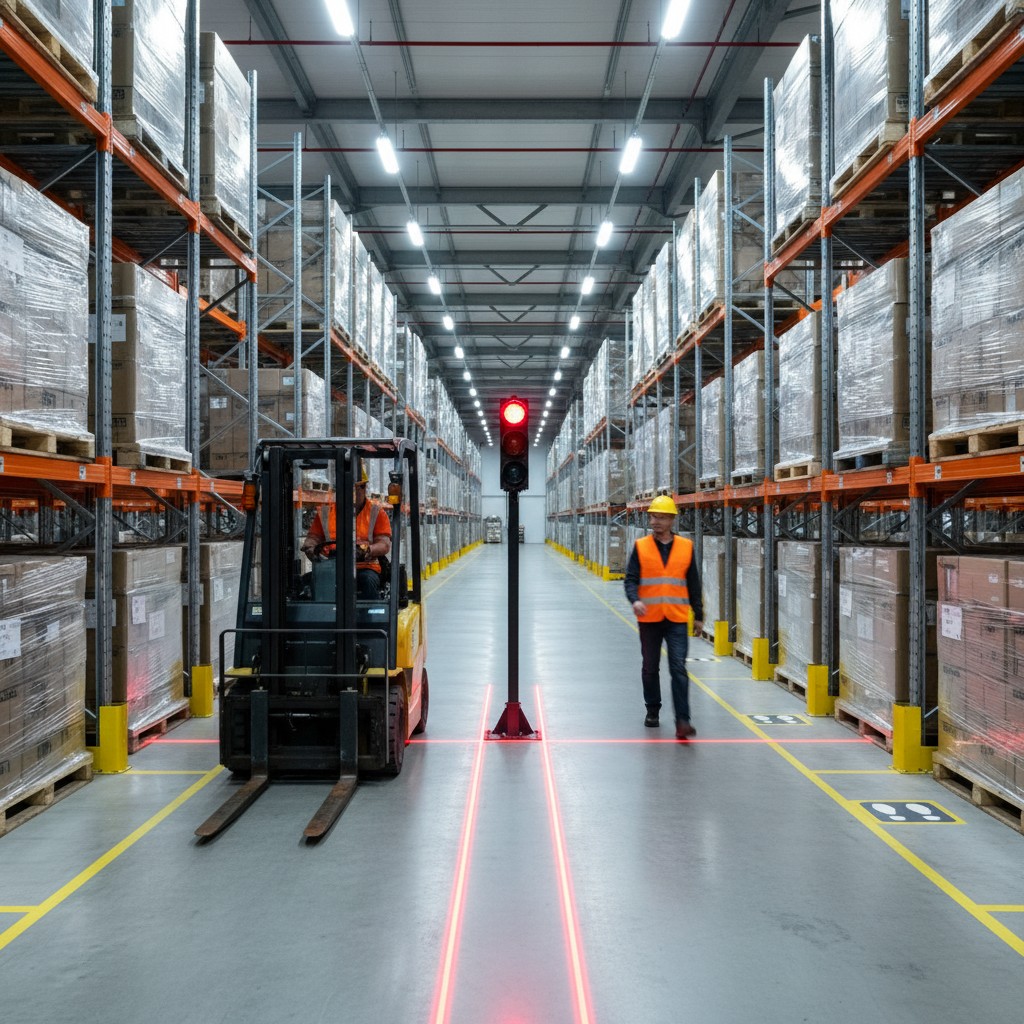
IES approaches warehouse traffic like a city approaches road traffic: with engineered infrastructure that manages flow, enforces limits, and coordinates intersections. Proximity sensors mounted at racking columns and ceiling structures detect both forklifts and pedestrians.
Speed zones automatically enforce safe speeds at intersections, blind corners, and pedestrian crossings — without requiring any action from the operator. Gate arms physically control access at high-risk points.
Floor projectors mark active hazard zones in real time, visible even in noisy environments. Traffic lights coordinate right-of-way at busy crossings so forklifts and pedestrians never occupy the same space simultaneously.
Every component communicates with every other — one integrated system, not a collection of disconnected safety products installed separately.
03 — Implementation
How Do Zone-Based Speed Limits Work?
Different areas of your facility carry different risk profiles, and a single speed limit across the entire floor does not reflect that reality. Open aisles used only by forklifts can tolerate higher travel speeds.
Blind corners, dock crossings, and active pedestrian walkways require strict limits. IES configures automatic speed zones that slow forklifts as they enter high-risk areas — no operator action required.
RFID antennas or magnetic zone markers define each zone boundary. When a forklift enters a zone, the Guardian system reads the zone speed limit and enforces it directly through the vehicle control interface.
Speed limits are enforced by the system, not by signage. Zone boundaries and limits are configured in software and can be updated as facility layout changes.
Frequently Asked Questions
Get Started
Ready to eliminate your blind spots?
How it works
Answer 7 quick questions about your facility and get an instant risk score with tailored recommendations.
- Evaluate your facility type, fleet size, and traffic patterns
- Instant risk score from 1–10
- Tailored engineering control recommendations
Takes about 2 minutes · No obligation