01 — Forklift Safety Product Selection
Forklift Safety Products — Sensors, Lights & Detection
The right forklift safety products — blue spot lights, proximity sensors, speed limiters, collision avoidance systems, and pedestrian detection — selected and integrated for your fleet by IES.
01 — Forklift Safety Product Selection
What Types of Forklift Safety Products Are Available?
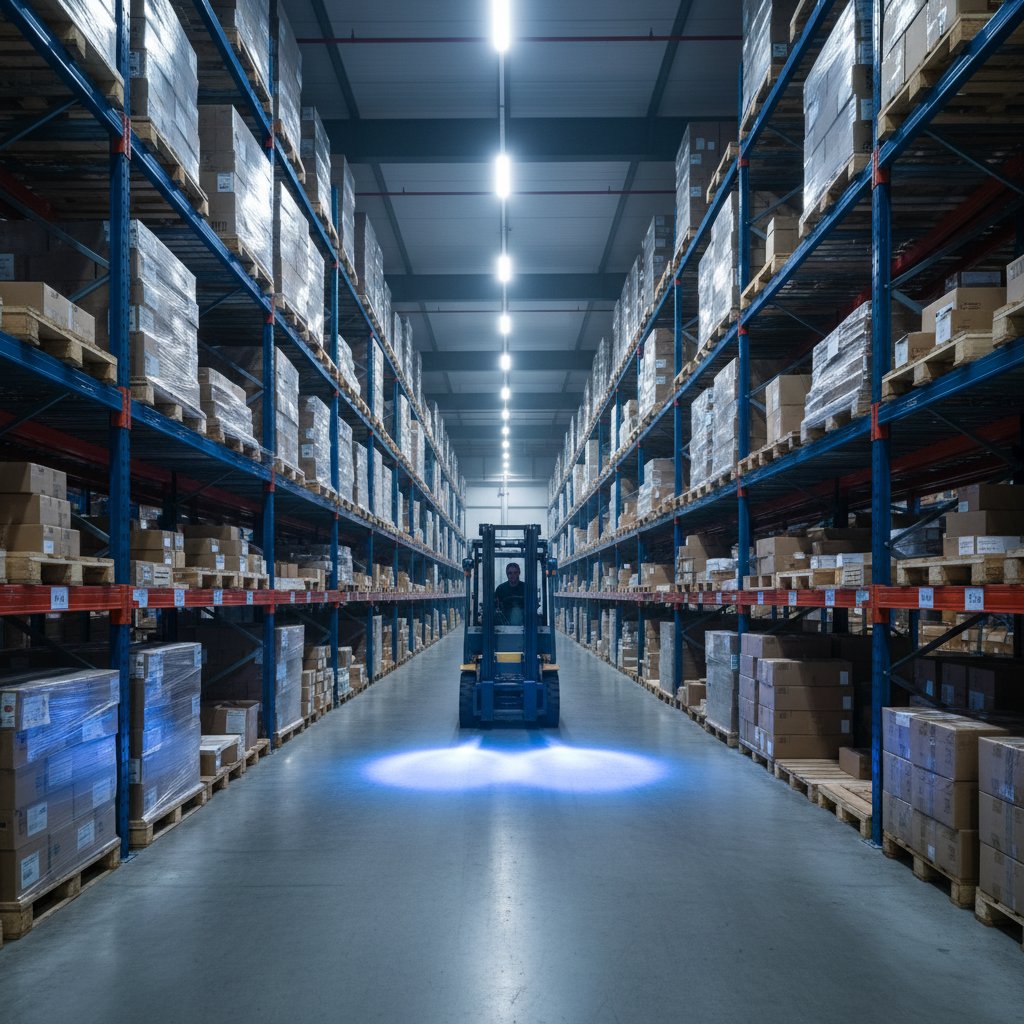
Forklift safety products span several distinct categories. Blue spot lights and red zone projectors mount on forklifts and project visual warnings on floors and walls to alert pedestrians of approaching equipment.
Proximity sensors — using RFID fobs, UWB, or LiDAR — detect when pedestrians enter a configurable zone around the forklift. Speed limiters and governor systems cap vehicle speed by zone with no driver input required.
Collision avoidance systems combine detection with automated speed reduction and alerting. Pedestrian detection fobs are wearable devices that communicate with forklift receivers to trigger coordinated responses.
Overhead projectors and bay door LED indicators are facility-mounted products that complement forklift-mounted equipment. IES installs and integrates the full product range — forklift-mounted and facility-mounted — as part of a coordinated Guardian safety system.
02 — Deep Dive
How Do Standalone Products Compare to Integrated Safety Systems?
Standalone forklift safety products address one risk scenario at one point. A blue spot light warns pedestrians of one forklift's approach in one location.
A speed limiter enforces one speed without knowing whether a pedestrian is nearby. A proximity sensor alerts the driver without automatically slowing the forklift.
Each standalone product improves one dimension of safety but leaves the others unchanged. Integrated systems coordinate across all product categories: when a proximity event is detected, the forklift slows automatically, visual alerts activate for both operator and pedestrian, and the event is logged for compliance.
In complex facilities with multiple blind corners, dock crossings, and pedestrian traffic zones, this integration is what converts individual product effectiveness into facility-wide incident reduction. IES designs integration programs that connect each product into one coordinated Guardian system.
03 — Implementation
How Does IES Select and Integrate the Right Products for Each Facility?
Product selection starts with understanding the risk profile of each area in your facility, not with a product catalog. IES begins with a facility assessment that maps traffic patterns, identifies blind spots and high-risk intersections, and reviews incident and near-miss history.
Each zone receives an individually specified product set based on its risk profile: a high-volume dock crossing needs detection, speed management, visual alerts, and gate arm integration; a low-frequency racking end corner might need an overhead projector and zone-based speed reduction alone. After the assessment, IES provides a written product specification and cost estimate.
Post-installation, Guardian's event logging shows which zones generate the most proximity events, informing ongoing product configuration adjustments as your facility's operations change.
Frequently Asked Questions
Get Started
Ready to eliminate your blind spots?
How it works
Answer 7 quick questions about your facility and get an instant risk score with tailored recommendations.
- Evaluate your facility type, fleet size, and traffic patterns
- Instant risk score from 1–10
- Tailored engineering control recommendations
Takes about 2 minutes · No obligation